
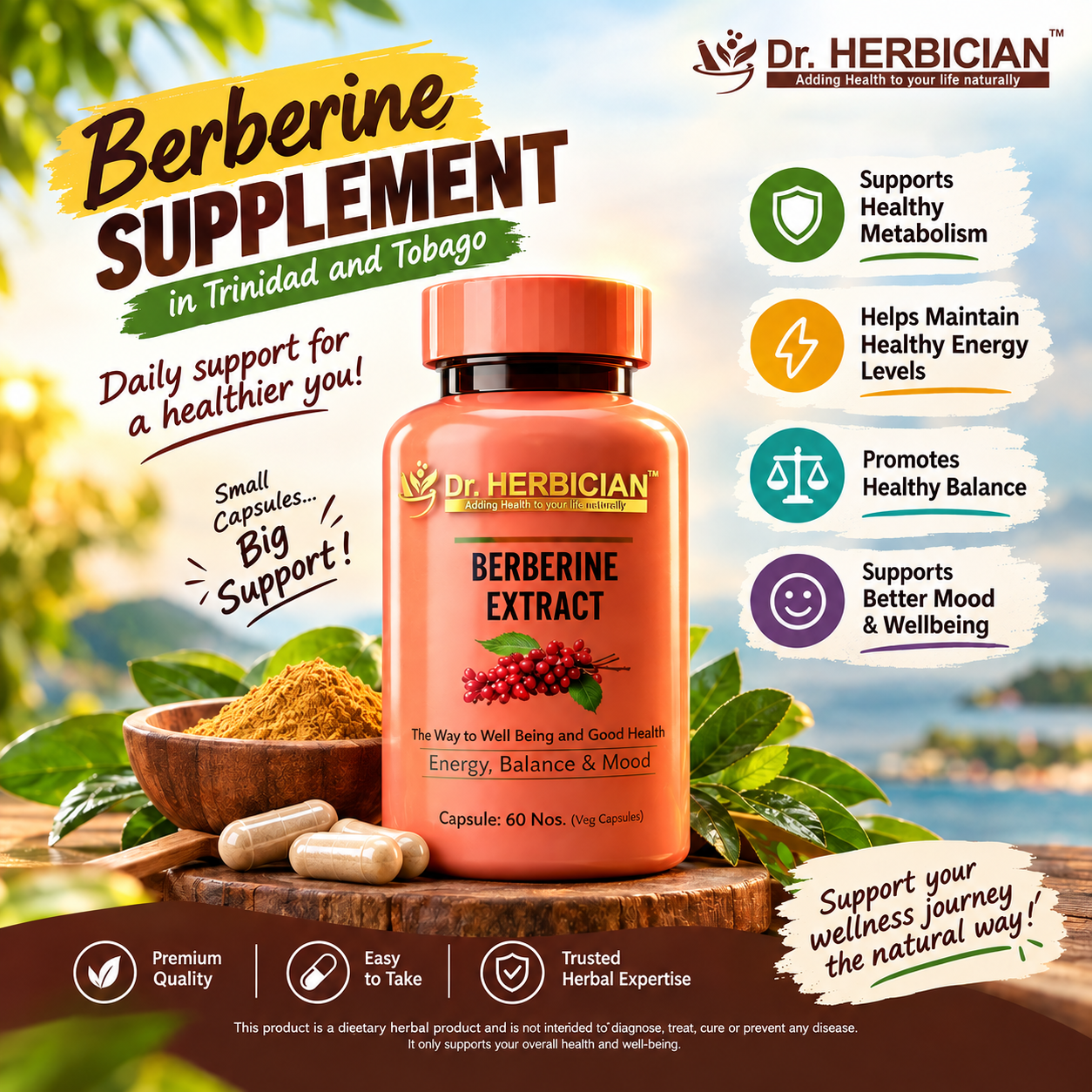
Berberine Supplement Guide: Understanding Dr. Herbician Berberine Extract in Trinidad and Tobago.
Why Are People Searching for Berberine?
More people across Trinidad and Tobago are paying closer attention to what goes into their daily wellness routines. Along with that shift has come growing curiosity about botanical ingredients — and berberine is one that keeps coming up. Whether it’s from a conversation at the pharmacy counter, a wellness forum, or a friend’s recommendation, many people want to understand what berberine actually is before deciding whether it belongs in their own routine.
It’s worth saying clearly upfront: not everyone needs a berberine supplement, and this guide isn’t here to convince you that you do. Instead, this article walks through what berberine is, what current research is exploring, and what to look for if you’re considering a berberine supplement — including Dr. Herbician Berberine Extract, a botanical dietary supplement for adults who want to learn more about this compound.
Quick answer: A berberine supplement is a dietary supplement containing berberine, a naturally occurring botanical compound found in certain plants. Berberine has been studied for several potential biological effects, but research findings vary by condition, formulation, dosage, and population. A berberine supplement should not be treated as a replacement for prescribed medical care.
What Is Berberine and Why Is It Discussed in Wellness Research?
Berberine is a naturally occurring plant compound that belongs to a group of substances known as alkaloids. It’s found in a number of different plants, including several species that have a long history of use in traditional herbal practices around the world.
A few basics worth understanding:
- Berberine is a compound, not a single plant — it can be extracted from more than one type of berberine-containing plant.
- The same compound can appear in different forms across the supplement market: as a berberine extract, as part of a whole-herb product, or within a standardized formulation.
- Concentration, extraction method, and overall quality can vary significantly between one product and the next.
- Not every product labeled “berberine” comes from the same plant, the same plant part, or the same manufacturing process.
It helps to understand the vocabulary you’ll run into while researching:
- Berberine (the compound): the specific alkaloid itself.
- Berberine extract: a preparation where berberine has been drawn out of a plant source, often at a higher concentration than the raw plant material.
- Whole-herb product: a supplement made from the dried or processed plant itself, without isolating the compound.
- Root supplement: a term used when a product’s ingredient is specifically sourced from a plant’s root or rhizome.
- Standardized extract: an extract manufactured to contain a guaranteed, consistent amount of the active compound in every batch.
We won’t describe Dr. Herbician Berberine Extract using any of these more specific terms — standardized, root-sourced, or otherwise — unless that detail is confirmed on the official product label. If you’re comparing products, the label is where these details should be verified, not marketing copy.
What Should You Know Before Choosing a Berberine Supplement?
A berberine dietary supplement is, at its core, a product formulated to deliver berberine in a convenient format — usually capsules or tablets. People choose botanical supplements like this for a range of personal reasons: curiosity about a specific plant compound, interest in botanical wellness generally, or a desire to explore options alongside conversations with a healthcare provider.
A few things matter more than marketing language when you’re evaluating any berberine supplement:
- The product label matters more than the packaging. It’s the only reliable source for what’s actually inside.
- Dosage and formulation vary widely between brands, so a review or forum post about “berberine” in general may not apply to the specific product in front of you.
- Supplements should come from transparent, reliable sources that are willing to disclose ingredient details, manufacturing information, and clear usage instructions.
It’s also worth being direct about something the supplement industry doesn’t always say plainly: dietary supplements are not automatically equivalent to medicines, and “natural” does not automatically mean risk-free. Botanical compounds can still interact with medications or existing health conditions, which is part of why professional guidance matters (more on that in the safety section below). Dr. Herbician Berberine Extract is presented as a dietary supplement — not as a medicine, and not as a treatment for any condition.
What Does Research Say About Berberine?
This is the part of the conversation that deserves the most care, because it’s easy for research summaries to drift into product promises. They shouldn’t.
Researchers have investigated berberine in relation to a number of areas, including:
- Glucose metabolism
- Lipid- and cholesterol-related markers
- General metabolic health
- Digestive and gut-related processes
- Cellular pathways
- Antioxidant activity observed in laboratory studies
- Inflammatory pathways studied in preclinical (non-human) research
Here’s the important nuance: these are areas of scientific inquiry, not confirmed outcomes for any particular product. Some studies suggest certain effects in specific contexts. Evidence in many of these areas is still developing. Human clinical research on berberine has real limitations — differences in dosage, study duration, population size, and formulation all affect results, and results may vary from one study to the next.
It’s also important to distinguish between different types of research:
- Laboratory (in vitro) studies look at berberine’s effects on cells or compounds in a controlled lab setting — findings here don’t automatically translate to how a supplement behaves in a person’s body.
- Animal studies provide another layer of evidence, but animal physiology differs from human physiology in meaningful ways.
- Observational studies in humans can identify patterns or associations, but they don’t prove cause and effect.
- Human clinical trials are generally considered stronger evidence, though even these vary in quality, size, and design.
More research is needed across the board, and no research area discussed here should be read as a claim about what Dr. Herbician Berberine Extract — or any berberine product — actually does for an individual person. Readers interested in the underlying science are encouraged to consult peer-reviewed journals, recognized medical institutions, or government health resources directly, since this article is not a substitute for reviewing primary research.
Potential Wellness Support Without Medical Promises.
Given everything above, how do people actually think about berberine within a wellness routine — without crossing into territory this article isn’t allowed to promise?
Some reasonable, appropriately hedged ways consumers frame it:
- As one botanical ingredient that has been studied in nutrition and health research, among many others.
- As something that may be considered as part of a broader, structured wellness routine — not a standalone fix.
- As a topic worth discussing with a healthcare professional if someone is already considering adding a new supplement to their routine.
- As something that may complement healthy lifestyle habits already in place, depending entirely on individual circumstances.
What this section is not saying: that berberine — or Dr. Herbician Berberine Extract specifically — lowers blood sugar, reduces cholesterol, burns fat, causes weight loss, treats insulin resistance, prevents diabetes, cures inflammation, detoxifies the body, or replaces medication. Those are disease-related claims, and none of them are being made here. If you see a supplement seller making claims like these outright, that’s worth treating as a red flag rather than reassurance.
Is Berberine the Same as a Root Supplement?
Not necessarily — and this is a common point of confusion.
“Root supplement” describes a product whose ingredient comes specifically from a plant’s root or rhizome. Berberine, however, can be obtained from several different berberine-containing plants, and depending on the manufacturer, it may be sourced from roots, stems, bark, or other plant parts. In other words:
- Some botanical supplements are built around roots, rhizomes, stems, bark, or leaves — the plant part used depends entirely on the specific product and manufacturer.
- Berberine is not tied to one single plant part across the entire supplement category.
- The only way to know whether a specific berberine product qualifies as a “root supplement” is to check the botanical name and plant part listed on that product’s label.
We’re not describing Dr. Herbician Berberine Extract as a root supplement in this article, because that would require confirming the specific botanical source and plant part from official product information. If that detail matters to you, look for it directly on the label or product page before purchasing any berberine product — not just this one.
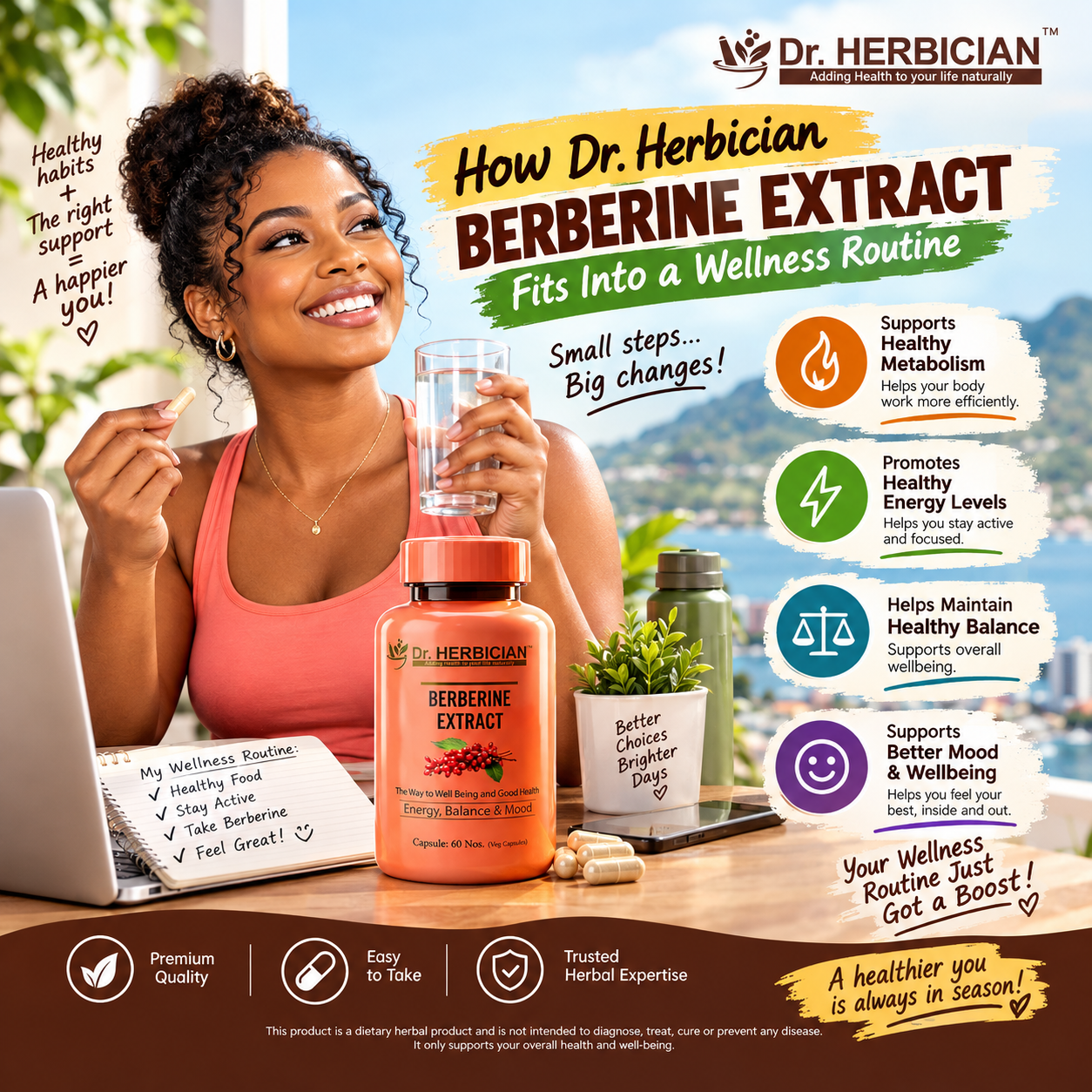
How Dr. Herbician Berberine Extract Fits Into a Wellness Routine.
With the groundwork laid, here’s where Dr. Herbician Berberine Extract fits into the picture.
Dr. Herbician Berberine Extract can be presented as a botanical dietary supplement for adults who are exploring berberine as part of an informed wellness routine. Like any supplement in this category, its value to a given person depends on individual health circumstances, existing medications, and personal wellness goals — which is exactly why generic dosage advice or blanket recommendations aren’t offered here.
What we can say responsibly:
- It falls within the broader category of botanical or herbal dietary supplements.
- As with any supplement, the official product label is the authoritative source for serving size, ingredients, and usage instructions.
- Consumers should review that label carefully and seek professional advice if they have existing health conditions, take medication, or fall into any of the higher-caution groups discussed in the safety section below.
What we’re intentionally not inventing: a specific dosage, timing recommendations, a suggested “cycle” of use, clinical outcomes, manufacturing certifications, or guaranteed benefits. If that information isn’t confirmed on the official Dr. Herbician product label or product page, it doesn’t belong in this article — and it shouldn’t factor into your purchase decision from any third-party source either. Go to the label first.
Why Product Quality and Transparency Matter.
With so many wellness supplement brands competing for attention, it helps to know what actually separates a transparent product from a vague one. Here’s a practical checklist to run through when comparing any berberine supplement — Dr. Herbician‘s or otherwise:
- Full ingredient list — every active and inactive ingredient should be disclosed.
- Botanical name and plant part — vague terms like “herbal blend” without specifics are a caution sign.
- Amount per serving — clearly stated, not buried or omitted.
- Extraction details, when the manufacturer chooses to provide them.
- Manufacturing information, including where and how the product is made.
- Batch or lot number — useful for quality tracking and recalls.
- Expiry date — always check this, especially in a warm climate (more on that shortly).
- Storage instructions — proper storage affects potency and safety over time.
- Allergen information — clearly listed, not assumed.
- Clear warnings — legitimate products don’t hide contraindications.
- Contact information — a real, reachable manufacturer or distributor.
- Authentic distribution channels — buying through verified sellers rather than unofficial resellers.
- Transparent claims — language that matches what’s actually been demonstrated, not exaggerated promises.
None of this is a claim that Dr. Herbician is “the best” brand on the market — that kind of statement would need independent, verifiable evidence to back it up, and this article isn’t making it. What’s useful here is the checklist itself: apply it to any wellness supplement brand you’re evaluating, including this one. And generally, treat phrases like “best supplement in the world,” “guaranteed results,” “100% effective,” “miracle supplement,” “risk-free,” or unverified “doctor-approved” labeling as signals to look more closely, not signals of quality.
How Is Berberine Different From a Multivitamin?
This is one of the most common points of confusion for people newer to supplement shopping, so it’s worth spelling out plainly.
| Supplement type | General purpose |
|---|---|
| Berberine supplement | Provides berberine, a botanical compound |
| Multivitamin dietary supplement | Provides selected vitamins and minerals |
| Wellness multivitamin | Broad term for a supplement containing multiple nutrients |
| Immunity multivitamin | Usually marketed around nutritional support for normal immune function |
| Herbal extract | Provides one or more plant-derived ingredients |
| Mineral supplement | Provides one or more minerals |
A berberine supplement is not a substitute for a multivitamin dietary supplement, and a wellness multivitamin is not a substitute for a berberine supplement — they’re built around entirely different ingredient categories and serve different purposes within someone’s overall routine. The same goes for an immunity multivitamin, which is generally formulated around nutrients associated with normal immune function rather than a single botanical compound. Unless a product’s label specifically lists added vitamins or minerals, it’s safest to assume a berberine supplement provides berberine and nothing more.
Comparing Berberine With Other Supplement Categories.
Beyond multivitamins, a few other product categories occasionally come up in the same searches or store aisles as berberine — and they’re worth distinguishing clearly so you’re not comparing apples to oranges:
- A tablet for energy is typically formulated around ingredients associated with energy or alertness — which may or may not include botanical compounds, but isn’t the same formulation category as a berberine extract.
- A Curcuma Amada supplement is a separate botanical product entirely, built around a different plant and a different ingredient profile than berberine.
- Melatonin Gummies Cranberry Flavor are associated with sleep-wake timing and nighttime wellness routines — a completely different use case than anything discussed in this article.
These products aren’t interchangeable, and none of them should be swapped for one another based on category alone. Choosing between them comes down to what you’re actually trying to address, ideally with input from a pharmacist or healthcare professional rather than guesswork. To be clear: Dr. Herbician Berberine Extract isn’t being positioned here as an energy product or a sleep aid — those claims would require a verified formulation designed for those specific purposes, which isn’t what this article is describing.
What Should Consumers in Trinidad and Tobago Consider Before Buying?
Location matters more than people sometimes realize when it comes to supplements. A few things worth thinking through if you’re shopping for a berberine supplement in Trinidad and Tobago:
- Buy from reliable, verifiable sellers. Established distributors or retailers with a real storefront (physical or online) are generally easier to hold accountable than anonymous sellers.
- Check labels and expiry dates carefully before purchase, not after you’ve already opened the bottle.
- Consider local storage conditions. Trinidad and Tobago’s warm, humid climate can affect how supplements hold up over time — following any storage instructions on the label (like keeping products in a cool, dry place away from direct sunlight) matters more here than in a temperate climate.
- Be cautious of vague or exaggerated marketing, particularly for products with unclear or incomplete ingredient disclosures.
- Confirm the product is intended for adults, unless a pediatric formulation is specifically labeled and appropriate.
- Ask a pharmacist or healthcare professional about potential interactions before starting any new supplement, especially if you’re already managing a health condition or taking medication.
- Be especially cautious with informal social-media sellers. Products sold through unofficial channels can be harder to verify for authenticity, storage history, or even basic ingredient accuracy.
- Keep all supplements away from children, stored securely regardless of packaging.
- Follow applicable local product and import requirements where relevant to your purchase method.
To be transparent: this article does not claim that Dr. Herbician Berberine Extract carries any specific local regulatory registration, approval, or authorization in Trinidad and Tobago. If that kind of verification matters to your purchase decision, it should be confirmed directly through an official source — not assumed from a blog post. Similarly, no specific local pricing, retailer information, or customer reviews are cited here, since none of that has been independently verified for this article.
Safety, Precautions, and Responsible Use.
This is the section that matters most, regardless of which berberine product you’re considering.
Berberine may interact with certain medicines, and it may not be appropriate for everyone. It’s strongly advisable to consult a qualified healthcare professional before using a berberine supplement if you:
- Are pregnant or breastfeeding
- Are planning a pregnancy
- Are taking any prescription medication
- Use medicines that affect blood glucose
- Use medicines that affect blood pressure
- Use medicines that affect blood clotting
- Take medicines processed through specific liver enzymes
- Have a diagnosed medical condition of any kind
- Have liver or kidney concerns
- Have a history of allergic reactions to botanical ingredients
- Are preparing for surgery
- Are considering giving a supplement to a child or teenager
Some people report digestive discomfort, nausea, constipation, diarrhea, or abdominal discomfort when using berberine products, though this varies by individual and by product — it isn’t something that happens to everyone, and it isn’t a guarantee that it won’t happen to you either.
A few responsible-use basics worth repeating regardless of brand:
- Don’t exceed the directions on the product label.
- Don’t combine multiple berberine products at once without professional advice.
- Don’t stop a prescribed medication in order to use a supplement instead.
- Don’t treat any supplement as a substitute for a proper medical diagnosis or treatment plan.
- Stop use and seek medical advice promptly if you experience any concerning symptoms.
Common Mistakes to Avoid When Choosing a Berberine Supplement.
A handful of avoidable missteps come up again and again when people shop for botanical supplements:
- Choosing a product just because the word “natural” appears on the label.
- Skipping the ingredient list entirely.
- Not checking how much berberine is actually in each serving.
- Assuming every berberine product on the shelf has the same formulation, source, or concentration.
- Believing marketing that implies a supplement cures or prevents a disease.
- Combining several supplements at once without checking for interactions.
- Using a product past its expiry date, especially after storage in a warm, humid environment.
- Buying from a seller you can’t verify or contact.
- Skipping professional advice because a product “seems safe.”
- Expecting any supplement to substitute for a healthy diet, regular exercise, adequate sleep, or prescribed medical treatment.
Avoiding these mistakes goes a long way toward making a more informed decision — whichever brand or product you ultimately choose.
Who May Consider Learning About Berberine?
This article may be useful for adults who:
- Want to understand berberine as a botanical ingredient before making a purchase decision.
- Are actively researching dietary supplement options and comparing categories.
- Want to compare different wellness supplement brands on transparency and label detail.
- Are interested in reading about the current state of botanical research, with its limitations in mind.
- Want a clearer sense of what to look for on a supplement label.
- Are considering raising berberine as a topic in an upcoming conversation with a healthcare professional.
To reiterate a point made earlier: this isn’t a suggestion that everyone should be taking berberine, nor a recommended dosage, nor a claim that any particular product suits every person. Those decisions belong with you and your healthcare provider.
Frequently Asked Questions.
1. What is a berberine supplement? A berberine supplement is a dietary supplement formulated to contain berberine, a naturally occurring botanical alkaloid found in certain plants. It is sold as a wellness product, not as a medicine, and is not intended to diagnose, treat, cure, or prevent any disease.
2. What is berberine extracted from? Berberine can be extracted from several different plants, depending on the manufacturer. The specific botanical source and plant part used vary by product, so it’s important to check the label of any specific berberine supplement rather than assuming all products share the same source.
3. Is berberine a medicine or a dietary supplement? Berberine-containing products sold as supplements, including Dr. Herbician Berberine Extract, are classified and marketed as dietary supplements — not medicines. They are not intended to replace prescribed medical treatment.
4. What is Dr. Herbician Berberine Extract? Dr. Herbician Berberine Extract is a botanical dietary supplement containing berberine, intended for adults exploring berberine as part of an informed wellness routine. Specific formulation details should be confirmed on the official product label.
5. Is berberine the same as a root supplement? Not always. “Root supplement” refers specifically to products sourced from a plant’s root or rhizome. Berberine can come from various plant sources and parts, so whether a specific product qualifies as a root supplement depends on that product’s confirmed botanical source.
6. What should I check before buying a berberine supplement in Trinidad and Tobago? Check the ingredient list, berberine amount per serving, expiry date, storage instructions, and seller authenticity. Given the local climate, proper storage matters, and buying from a verifiable seller helps avoid counterfeit or degraded products.
7. Can berberine interact with medication? Berberine may interact with certain medications, including those affecting blood glucose, blood pressure, or blood clotting. Anyone taking prescription medication should consult a healthcare professional before starting a berberine supplement.
8. Who should avoid using berberine without professional advice? Pregnant or breastfeeding individuals, people taking prescription medication, those with liver or kidney concerns, people preparing for surgery, and anyone considering giving it to a child or teenager should speak with a healthcare professional first.
9. Is a berberine supplement the same as a multivitamin dietary supplement? No. A berberine supplement provides a single botanical compound, while a multivitamin dietary supplement provides a selection of vitamins and minerals. They serve different roles and aren’t interchangeable.
10. What is the difference between a wellness multivitamin and a berberine supplement? A wellness multivitamin is a broad category of nutrient-based supplements, typically covering multiple vitamins and minerals. A berberine supplement is centered on one specific botanical compound and doesn’t provide the same nutrient profile.
11. Is berberine suitable for everyone? No single supplement is suitable for everyone. Suitability depends on individual health status, current medications, and personal circumstances — which is why professional guidance is recommended before starting any new supplement.
12. Can a berberine supplement replace prescribed treatment? No. Berberine supplements, including Dr. Herbician Berberine Extract, are not intended to replace prescribed medication or medical treatment. Anyone under medical care should continue following their prescribed treatment plan and consult their provider before adding a supplement.
13. What should I look for when comparing wellness supplement brands? Look for a full ingredient list, clear serving information, manufacturing transparency, batch and expiry details, storage instructions, allergen disclosures, and realistic, non-exaggerated claims.
14. Is Curcuma Amada supplement the same as berberine? No. Curcuma Amada supplement is a different botanical product with its own distinct ingredient profile, separate from berberine-based supplements.
15. Is Melatonin Gummies Cranberry Flavor similar to berberine? No. Melatonin Gummies Cranberry Flavor are associated with sleep-wake timing and nighttime wellness, which is a different use case entirely from a berberine supplement.
Dr. Herbician Berberine Extract is a dietary supplement, not a medicine. It is not intended to diagnose, treat, cure, or prevent any disease. Individual responses may vary. Follow the product label and consult a qualified healthcare professional before use, especially if you are pregnant, breastfeeding, taking medication, preparing for surgery, or managing a medical condition.