
Introduction.
If you’ve come across the term “Curcuma Amada supplement” and aren’t quite sure what it means, you’re not alone. Curcuma Amada — sometimes called mango ginger — is a rhizome-based botanical that’s been used in traditional herbal practices for generations, but it’s only recently started appearing on supplement shelves as an extract. This guide explains what it actually is, where it comes from, and what to look for before choosing a product.
It’s worth saying clearly from the start: a Curcuma Amada supplement is a dietary or herbal supplement, not a medicine. It isn’t intended to diagnose, treat, cure, or prevent any disease. What it can offer is a way to explore a traditional botanical as part of a broader, balanced wellness routine — provided you understand what the science does and doesn’t currently support.
For readers in Trinidad and Tobago, where herbal remedies and root-based ingredients are already part of everyday life, Curcuma Amada may feel familiar in spirit even if the name is new. This article walks through the botany, the traditional and research context, and the practical questions worth asking before buying any Curcuma Amada supplement — including Dr. Herbician Curcuma Amada Extract, which we’ll introduce along the way as one example of a brand offering this ingredient.
What Is Curcuma Amada?
Curcuma Amada (scientific name Curcuma amada Roxb.) is a perennial rhizomatous herb belonging to the ginger family, Zingiberaceae. It’s commonly known as “mango ginger” because its rhizome looks similar to fresh ginger but gives off a distinctive raw-mango aroma when cut. It’s native to India and is also found or cultivated in parts of South and Southeast Asia.
Root or rhizome? Curcuma Amada is a rhizome-based botanical — the part used is an underground stem (rhizome), not a true root, though rhizomes are commonly grouped with roots in everyday supplement language. This is the same plant part traditionally harvested, cleaned, and dried before being processed into powder or extract.
Curcuma Amada extract, explained. A Curcuma Amada extract is made by concentrating certain compounds out of the dried rhizome, typically through a solvent or processing method, rather than simply grinding the whole rhizome into powder. In general terms:
- Whole-root or rhizome powder contains the entire dried, ground rhizome, fibre and all.
- Extract is processed to concentrate specific plant compounds, which can mean a smaller serving delivers more of those compounds — though the exact ratio depends entirely on how a given product is made.
Because Dr. Herbician has not published specific extraction-ratio or standardization figures for public reference in this article, we won’t estimate or guess at them here. Anyone comparing rhizome powder to an extract should always check the individual product’s label rather than assume the two are interchangeable.
Is Curcuma Amada the same as turmeric? No. Curcuma Amada belongs to the same genus as turmeric (Curcuma longa) and the two plants look alike above and below ground, which causes frequent confusion. However, they are different species with different aroma profiles — turmeric has an earthy, slightly bitter character, while Curcuma Amada smells distinctly of raw mango — and different traditional uses. Curcuma Amada should not be assumed to share turmeric’s properties, and any claims about turmeric (such as its curcumin content) should not be applied to Curcuma Amada without separate evidence.
Curcuma Amada Traditional Uses and Wellness Research.
Curcuma Amada has a long history in traditional herbal systems, particularly Ayurveda and Unani medicine, as well as in South Asian cooking, where the rhizome is used fresh or pickled for its distinctive flavour.
Traditional use. In traditional herbal practices, Curcuma Amada rhizome has historically been used as an appetite-supporting botanical and has been referenced in folk and traditional literature in connection with digestive comfort, skin-related folk remedies, and general wellness practices. These are historical and cultural uses, not clinical claims.
Laboratory and preliminary research. Modern phytochemical studies have identified a range of compounds in Curcuma Amada rhizome, including essential oils and other plant constituents, and have investigated properties such as antioxidant and antimicrobial activity in laboratory settings. This research is genuinely interesting from a botanical standpoint, but it is largely preclinical — meaning it has mostly been conducted in laboratory or animal models rather than in large-scale human clinical trials.
What is not established. There is currently no strong body of human clinical evidence proving that Curcuma Amada treats, cures, or prevents any specific disease or medical condition. Research is ongoing, and individual experiences with any herbal supplement can vary considerably. Anyone drawing conclusions from early-stage laboratory research should treat it as a starting point for interest, not as proof of a health outcome.
The honest, useful way to think about Curcuma Amada is in three layers: what people have traditionally used it for, what scientists are currently studying it for, and what remains unproven. Keeping those three separate is the difference between responsible information and overpromising.
Curcuma Amada Supplement: Potential Wellness Support.
When people search for a Curcuma Amada supplement, they’re usually trying to understand what including it in their routine might reasonably offer. Based on its traditional use and the general category of botanical rhizome extracts, a Curcuma Amada supplement:
- May be included as part of a general, balanced wellness routine alongside good nutrition and lifestyle habits.
- May offer botanical antioxidant-related interest, consistent with the plant-compound research described above, though this should not be read as a guaranteed effect for any individual.
- Has traditionally been used in certain herbal wellness practices connected to digestive comfort — again, this is traditional use, not a treatment claim.
- May complement a balanced diet and healthy lifestyle habits, in the same general sense that many botanical ingredients are used to round out a wellness routine.
What it does not do, based on current evidence, is treat or cure joint conditions, digestive disorders, inflammation-related disease, or any other diagnosed medical condition. If you have a specific health concern, that’s a conversation for a doctor or pharmacist, not a supplement label.
Curcuma Amada as a Root Supplement.
Curcuma Amada is often described in everyday terms as a root supplement, even though botanically it comes from a rhizome rather than a true root. This distinction matters less for shopping purposes and more for understanding what you’re actually buying, since not all root or rhizome supplements are prepared the same way.
Why the plant part matters. The rhizome is the specific structure that traditional use and most of the available research actually refer to. A supplement made from leaves, flowers, or another part of the plant would not carry the same traditional or research context — so confirming that a product is rhizome-derived is a meaningful quality check.
Root powder vs. rhizome powder vs. extract. These are not interchangeable terms, even though they’re sometimes used loosely in marketing:
- Root or rhizome powder is the dried, ground plant material in its whole form.
- Extract is processed to concentrate specific compounds and is usually more potent by volume, though the degree depends on the extraction method used.
Why this matters for consumers. Two products both labelled “Curcuma Amada” could differ significantly depending on whether they use powder or extract, and depending on how that extract was made. This is exactly why reading the ingredient label — rather than assuming based on the product name alone — is essential.
Species matters too. Because Curcuma Amada is part of a genus with several similar-looking species (including turmeric and zedoary), a trustworthy label should clearly state the species (Curcuma amada) rather than a generic “curcuma” or “ginger family” descriptor. Different botanical species should never be treated as identical, even when they’re visually similar or closely related.
How to Choose a Quality Curcuma Amada Supplement.
Whether you’re looking at Dr. Herbician or any other brand, the same basic quality checks apply to a Curcuma Amada supplement:
1. Clearly identified botanical ingredient. The label should name Curcuma amada specifically, not just “curcuma” or “ginger extract.”
2. Correct plant part. Look for confirmation that the rhizome (root-like underground stem) is the part used.
3. Transparent ingredient list. A trustworthy product lists every ingredient, including any fillers, capsule material, or additional botanicals, rather than using vague blends.
4. Clear serving instructions. The label — not a blog post, and not guesswork — should be your source for how much to take and how often.
5. Product labeling and brand transparency. Look for a company that’s easy to identify, with clear contact information and accurate, non-exaggerated product descriptions.
6. Manufacturing and quality-testing information, where available. If a brand publishes information about how or where a product is made, or about quality testing, that transparency is a positive sign — but only rely on what’s actually published, not assumptions.
7. Storage instructions. Herbal extracts can be sensitive to heat, light, and moisture, so proper storage guidance protects product quality.
8. Realistic claims. Be cautious of any product — Curcuma Amada or otherwise — that promises to cure a disease, guarantee weight loss, or deliver “instant” results. Responsible supplement marketing uses cautious, evidence-aware language.
9. Product format. Confirm whether you’re buying a powder, capsule, tablet, or liquid extract, since this affects serving size, convenience, and how the product fits your routine.
No brand should be assumed to be “the best” or “highest quality” without independently verifiable evidence, and that standard applies to Dr. Herbician just as much as to any competitor.
Dr. Herbician and Wellness Supplement Brands.
With so many wellness supplement brands on the market, it helps to know what separates a responsible one from a purely sales-driven one. Look for:
- Accurate, non-exaggerated product descriptions.
- Transparent, legible labels with a full ingredient list.
- Clear usage instructions rather than vague “as needed” guidance.
- Responsible marketing that avoids disease-treatment claims.
- Realistic expectations rather than guaranteed outcomes.
- Accessible customer support for questions about the product.
- Proper storage information printed on the packaging.
- Appropriate warnings for pregnancy, medication use, or existing health conditions.
- Verified quality information where a brand chooses to share it.
Dr. Herbician is one brand offering a Curcuma Amada product in this space. As with any wellness supplement brand, the most useful approach is to research the specific product yourself, read the official label and product page, and compare that information against the quality checklist above — rather than relying solely on marketing claims from any single source, including this article.
Dr. Herbician Curcuma Amada Extract.
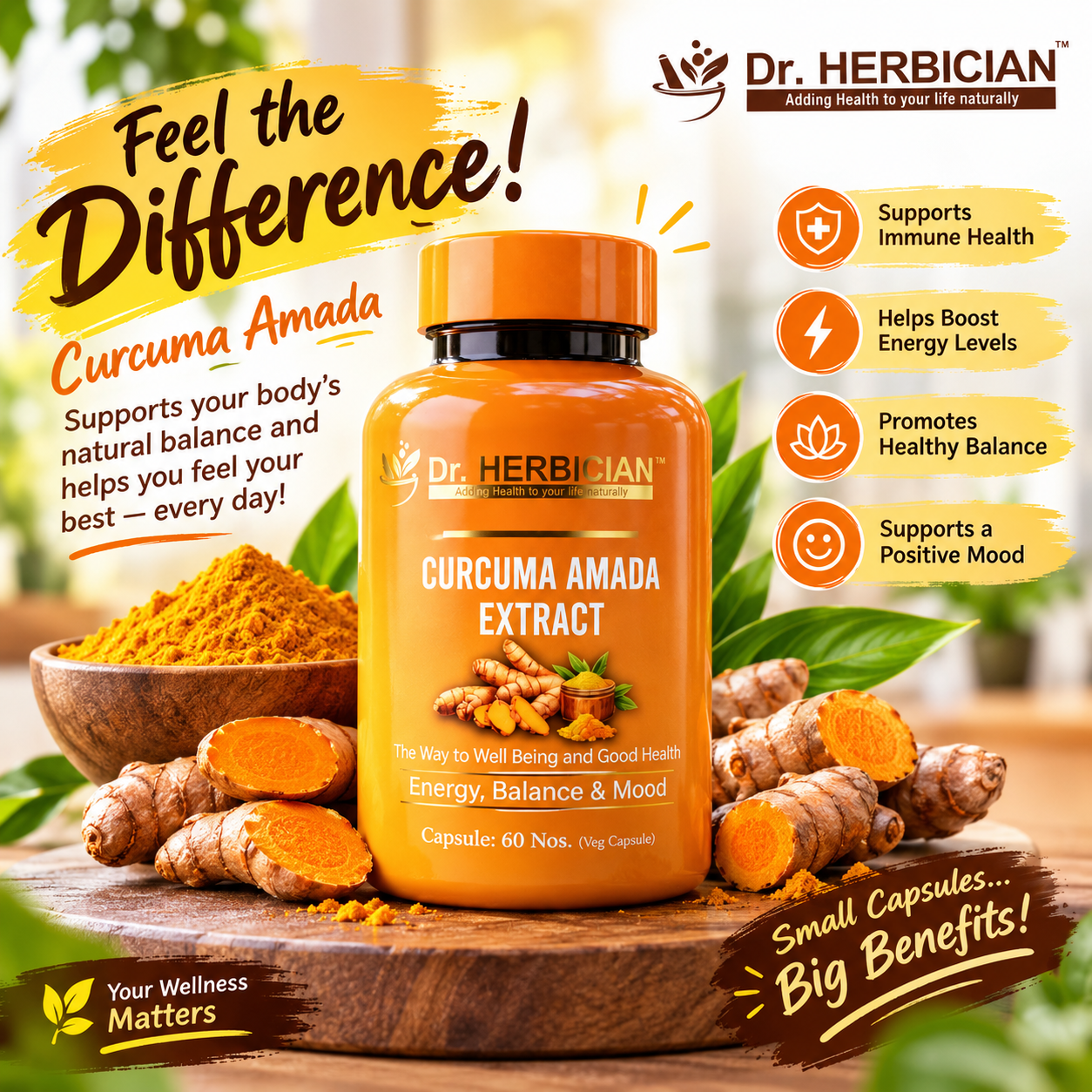
Dr. Herbician Curcuma Amada Extract is positioned by the brand as a herbal or dietary supplement built around the Curcuma Amada rhizome, offered in extract form.
Here’s what can be said responsibly about the product category it belongs to:
- Brand: Dr. Herbician
- Product: Dr. Herbician Curcuma Amada Extract
- Category: Herbal or dietary supplement, not a medicine
- Core ingredient: Curcuma Amada extract, derived from the plant’s rhizome
Because exact dosage, serving size, extraction ratio, standardization percentage, certifications, and clinical outcome data are not being invented for this article, the responsible approach — and the one we’d recommend to any reader — is to check the official Dr. Herbician product label and packaging for those specifics before use. A Curcuma Amada supplement, including this one, may be considered as part of a general wellness routine, alongside a balanced diet and healthy lifestyle habits, but it is not intended to replace medical treatment or professional healthcare advice.
If you’re evaluating Dr. Herbician Curcuma Amada Extract, apply the same buying-guide checklist from Section 10: confirm the botanical species and plant part, read the full ingredient list, follow the labelled serving instructions exactly, and don’t assume any wellness outcome that isn’t explicitly and responsibly stated on the packaging.
Curcuma Amada in Trinidad and Tobago.
Interest in herbal and botanical wellness products continues to grow across Trinidad and Tobago, where roots, rhizomes, and traditional plant remedies already have a familiar place in everyday life. Curcuma Amada — while perhaps less widely known by name than ginger or turmeric — fits into that same broader category of root-based botanicals worth understanding before you buy.
A few practical points for shoppers locally:
- Read labels carefully. Whether you’re buying online or in a local health store, take the time to check the ingredient list, plant species, and serving instructions rather than relying on the product name alone.
- Choose reliable sources. Look for sellers and brands that provide clear product information and are easy to contact with questions.
- Understand the traditional-versus-medical distinction. A Curcuma Amada supplement sits in the category of traditional herbal wellness, not medical treatment — that distinction matters regardless of where you’re shopping.
- Consider format and convenience. Whether a capsule, tablet, or liquid extract suits your daily routine is a personal choice worth thinking through before purchase.
- Follow storage guidance. Trinidad and Tobago’s climate makes proper storage — away from excess heat and humidity — particularly relevant for herbal extracts.
- Consult a healthcare professional when needed. If you’re pregnant, breastfeeding, managing a medical condition, or taking medication, a conversation with a doctor or pharmacist should come before adding any new herbal supplement, including a Curcuma Amada product.
This article doesn’t reference specific retailers, prices, availability, or sales figures in Trinidad and Tobago, since none of that has been independently verified — readers should check directly with retailers or the brand for current, accurate details.
Curcuma Amada Compared with Multivitamins and Other Supplements.
It’s worth being clear about how a Curcuma Amada supplement fits alongside other common supplement categories, since they’re not designed to do the same job.
A herbal supplement like Curcuma Amada extract is built around a single botanical ingredient and its traditional and research context. A multivitamin dietary supplement, by contrast, is typically formulated to provide a broad spread of essential vitamins and minerals that support general nutritional intake — it’s a different type of product with a different purpose entirely.
A wellness multivitamin is generally intended to fill everyday nutritional gaps, while a botanical extract like Curcuma Amada is centered on a single plant’s traditional and researched properties rather than broad-spectrum nutrition. The two aren’t competing products — they’re addressing different goals, and some people may use both as part of a wider routine, provided there’s no unnecessary ingredient overlap.
Similarly, an immunity multivitamin and a Curcuma Amada supplement are not interchangeable. An immunity-focused multivitamin is usually built around specific vitamins and minerals studied for general immune-related nutrition, while Curcuma Amada’s traditional and research context is different and shouldn’t be assumed to offer the same effect.
The multivitamin tablets benefits a person experiences will always depend on the specific ingredients in that formula and on that individual’s actual nutritional needs — there’s no universal benefit that applies to everyone equally. The same logic applies to a tablet for energy: these products commonly rely on different ingredients (such as specific vitamins or other compounds) aimed at a specific purpose, which is distinct from what a botanical rhizome extract like Curcuma Amada is traditionally used for.
The practical takeaway: before combining a Curcuma Amada supplement with a multivitamin, an immunity formula, or an energy tablet, check each product’s ingredient list for overlap, and consider asking a pharmacist if you’re unsure whether combining supplements makes sense for you.
How to Use a Herbal Supplement Responsibly.
General, non-medical guidance for using any herbal supplement, including a Curcuma Amada product:
- Follow the instructions printed on the official product label.
- Don’t exceed the recommended serving size.
- Avoid combining several supplements without first checking for overlapping ingredients.
- Store the product exactly as directed — typically somewhere cool, dry, and away from direct sunlight.
- Maintain a balanced diet rather than relying on any single supplement.
- Drink adequate water as part of your daily routine.
- Prioritize regular sleep and physical activity, which matter more for overall wellbeing than any single supplement.
- Pay attention to how your body responds when trying something new.
- Stop use and speak with a healthcare professional if you notice any unwanted reaction.
This guidance is general in nature and isn’t a substitute for personalized medical advice.
Safety Considerations.
Before using Curcuma Amada or any other herbal supplement, consult a qualified healthcare professional if you:
- Are pregnant or breastfeeding
- Take prescription medication or regular over-the-counter medication
- Have an existing medical condition
- Have a history of allergies to herbs, spices, or botanicals (including other Zingiberaceae-family plants like ginger or turmeric)
- Are preparing for surgery
- Have previously experienced a reaction to a herbal supplement
- Are simply unsure whether a Curcuma Amada supplement is appropriate for your situation
Disclaimer: Dr. Herbician Curcuma Amada Extract, and Curcuma Amada supplements generally, are dietary/herbal supplements. They are not intended to diagnose, treat, cure, or prevent any disease, and they are not a substitute for professional medical care or prescribed medication.
Frequently Asked Questions.
1. What is a Curcuma Amada supplement? A Curcuma Amada supplement is a dietary or herbal supplement made from the rhizome of Curcuma amada, commonly called mango ginger. It’s used to bring a traditional botanical into a wellness routine and is not classified or intended as a medicine.
2. What is Curcuma Amada extract? Curcuma Amada extract is a concentrated form of the plant’s rhizome, processed to isolate certain plant compounds rather than using the whole ground rhizome. Exact concentration varies by manufacturer, so it’s important to check individual product labels.
3. Is Curcuma Amada a root or rhizome supplement? Technically, Curcuma Amada comes from a rhizome — an underground plant stem — rather than a true root, though it’s commonly grouped with “root supplements” in everyday language. Either way, the rhizome is the specific plant part used.
4. What is Curcuma Amada traditionally used for? In Ayurvedic and Unani traditions, Curcuma Amada rhizome has historically been used as an appetite-supporting botanical and referenced for general digestive and wellness purposes, as well as in traditional cooking. These are historical, cultural uses rather than clinical claims.
5. What should I look for when choosing a Curcuma Amada supplement? Check that the label clearly names Curcuma amada, confirms the rhizome as the plant part used, lists every ingredient transparently, and gives clear serving instructions. Avoid products making exaggerated or disease-related claims.
6. How is a Curcuma Amada supplement different from a multivitamin dietary supplement? A Curcuma Amada supplement centers on one botanical ingredient and its traditional use, while a multivitamin dietary supplement typically provides a broad range of vitamins and minerals for general nutrition. They serve different purposes and aren’t interchangeable.
7. Is Curcuma Amada the same as turmeric? No. Curcuma Amada and turmeric (Curcuma longa) are related species in the same genus and look similar, but Curcuma Amada has a distinct raw-mango aroma and a different traditional-use profile. Curcuma Amada shouldn’t be assumed to share turmeric’s specific properties.
8. What does a quality herbal supplement label include? A quality label names the exact botanical species and plant part, lists all ingredients transparently, gives clear serving instructions, includes storage guidance, and avoids exaggerated or disease-treatment claims.
9. What should consumers in Trinidad and Tobago check before buying herbal supplements? Read the ingredient label carefully, buy from a reliable and transparent source, understand that herbal supplements are not medical treatments, consider storage suitability for a warm, humid climate, and consult a healthcare professional if you have any health concerns.
10. What is Dr. Herbician Curcuma Amada Extract? Dr. Herbician Curcuma Amada Extract is a herbal or dietary supplement from the Dr. Herbician brand, built around Curcuma Amada rhizome extract. Consumers should refer to the official product label for specific serving and ingredient details.
11. Can Curcuma Amada replace prescribed medicine? No. Curcuma Amada supplements are not intended to diagnose, treat, cure, or prevent disease, and they should never replace medication or treatment prescribed by a healthcare professional.
12. Who should consult a healthcare professional before using herbal supplements? Anyone who is pregnant or breastfeeding, takes medication, has an existing medical condition, has a history of allergic reactions to herbs, or is preparing for surgery should speak with a healthcare professional first.
13. How should Curcuma Amada supplements be used responsibly? Follow the official label’s serving instructions, avoid exceeding the recommended amount, check for ingredient overlap before combining with other supplements, store the product properly, and monitor how your body responds.
14. Is a Curcuma Amada supplement a tablet for energy? No. A Curcuma Amada supplement is a botanical extract product traditionally associated with digestive and general wellness use, not a tablet for energy, which typically relies on different ingredients formulated for that specific purpose.
15. Can Curcuma Amada be combined with other supplements? It’s possible, but you should first check for overlapping ingredients between products and consider speaking with a pharmacist, especially if you’re already taking a multivitamin, medication, or another herbal supplement.
Key Takeaways.
- Curcuma Amada (mango ginger) is a rhizome-based botanical from the Curcuma amada plant, related to but distinct from turmeric.
- “Curcuma Amada extract” refers to a concentrated processed form, different from whole rhizome powder — always check the label to know which one you’re buying.
- Traditional use of Curcuma Amada spans Ayurvedic, Unani, and culinary practices; scientific research is ongoing and largely preclinical.
- Before choosing any Curcuma Amada supplement, verify the botanical species, plant part, ingredient transparency, and serving instructions.
- A herbal supplement like Curcuma Amada and a multivitamin dietary supplement serve different purposes and aren’t interchangeable.
- Dr. Herbician Curcuma Amada Extract is one option in this category — evaluate it, like any product, against the official label and the quality checklist in this guide.
- Supplements are not a substitute for medical care, and Curcuma Amada is not intended to diagnose, treat, cure, or prevent any disease.
- Responsible use means following the label, watching for ingredient overlap, and consulting a healthcare professional when in doubt.
Soft Call to Action.
If you’re considering adding a Curcuma Amada supplement to your wellness routine, take a little time to do it right: look up Dr. Herbician Curcuma Amada Extract’s official product information, read the full ingredient list and directions, and weigh it against the quality checklist in this guide. As with any herbal supplement, if you’re pregnant, breastfeeding, on medication, or managing a health condition, check with a qualified healthcare professional before you start.