
Pure Ashwagandha Supplement Guide: What Consumers in Trinidad and Tobago Should Know.
Daily life in Trinidad and Tobago can move fast. Between work, family responsibilities, studies, traffic, and the everyday demands of keeping a household running, it’s easy for personal wellness to slide down the priority list. Many people find themselves looking for simple, realistic ways to support their overall wellbeing without overhauling their entire lifestyle overnight.
This is often where Ashwagandha enters the conversation. It’s a botanical ingredient with a long history of traditional use, and it has become increasingly common in wellness supplements sold around the world, including here in Trinidad and Tobago. But not all Ashwagandha products are the same, and choosing a pure ashwagandha supplement means understanding a few key things first: what the ingredient actually is, what “pure” really means on a label, how root differs from extract, and how to judge quality without relying on marketing language alone.
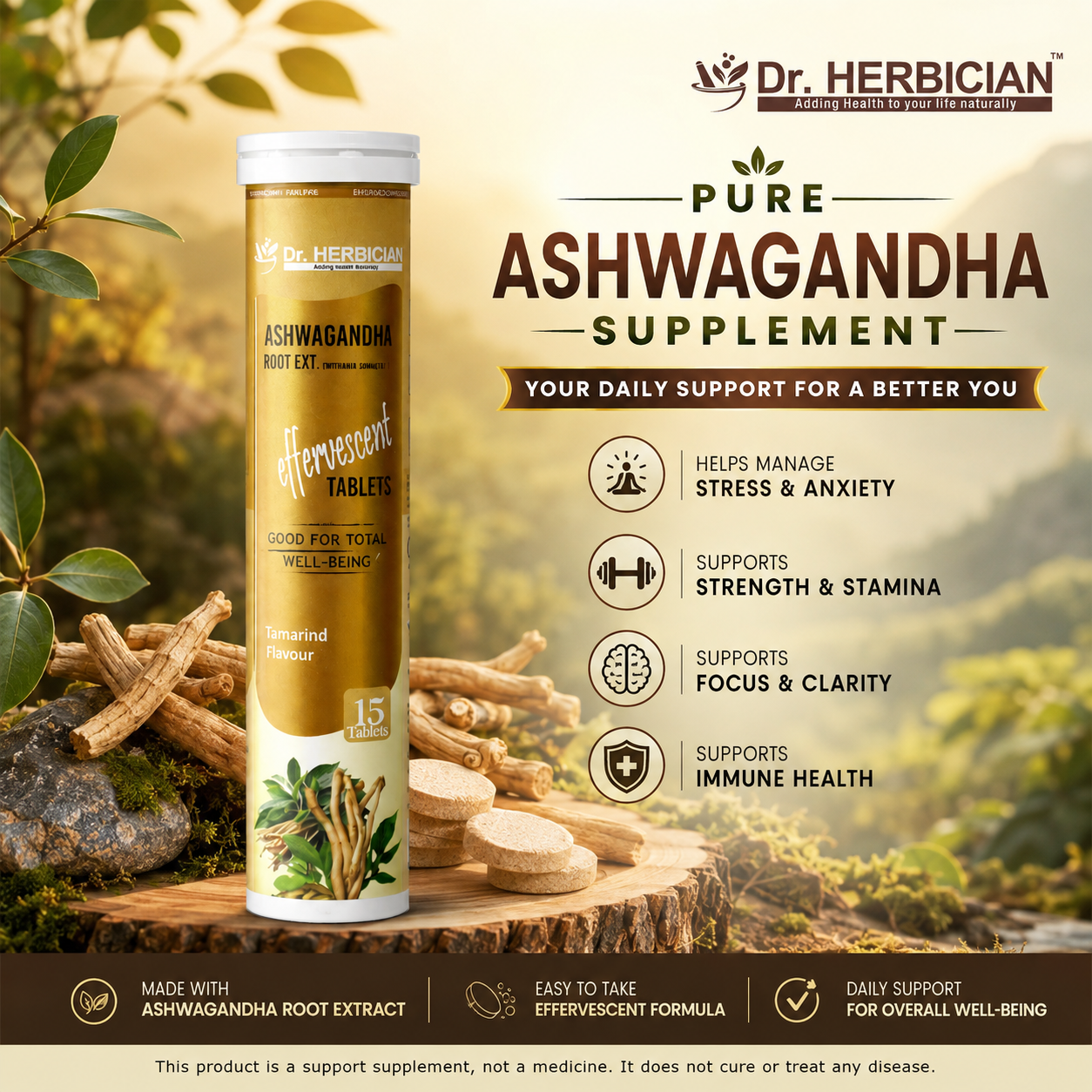
This guide walks through all of that in plain language. Along the way, we’ll also look at Dr. Herbician Ashwagandha Root Extract Effervescent Tablets – Tamarind Flavor, a supplement format designed for people who want a convenient, drinkable way to work Ashwagandha into a daily routine. The goal here is to inform first — so that whether or not you try this particular product, you leave with a clearer idea of how to evaluate any Ashwagandha supplement for yourself.
What Is Ashwagandha?
Ashwagandha, botanically known as Withania somnifera, is a plant that has been used for generations in traditional wellness practices, particularly within Ayurvedic tradition. The root of the plant is the part most commonly used in supplements, though other parts of the plant are sometimes referenced in traditional preparations as well.
Traditionally, Ashwagandha root has been prepared as a powder, decoction, or paste. In modern supplement manufacturing, the root is more often processed into a powder or extract form, which is then used in capsules, tablets, or effervescent formats. This is why you’ll frequently see Ashwagandha described as a “root-based” wellness ingredient — the root is the primary source material, even when the final product looks nothing like a raw root.
Ashwagandha is commonly included in wellness supplements because of its long-standing traditional use and its recognizable botanical identity. It’s important to be clear-eyed here: traditional use and modern scientific consensus are not the same thing, and this article does not claim that Ashwagandha is scientifically proven to cure or treat any medical condition. It is best understood as a traditional wellness botanical that many people choose to include as part of a broader healthy lifestyle.
What Does a Pure Ashwagandha Supplement Mean?
A pure ashwagandha supplement generally refers to a product where Ashwagandha root (in powder or extract form) is the primary active botanical ingredient, without being diluted by a long list of unrelated or filler ingredients that reduce its relevance on the label.
However, “pure” can be interpreted differently depending on the brand, the formulation, and the regulatory environment the product is sold in. It does not have one single, universally enforced legal definition across every market. That means the word “pure” on packaging is a starting point for research, not a guarantee in itself.
When evaluating whether a product is genuinely a straightforward Ashwagandha supplement, look at:
- The ingredient list — is Ashwagandha root or root extract clearly named, ideally with its botanical name (Withania somnifera)?
- The amount of Ashwagandha per serving — is this stated, or vague?
- The form used — root powder, root extract, or a standardized extract?
- Additional ingredients — flavorings, binders, or other botanicals, and whether they’re clearly disclosed?
- Serving instructions — is it clear how much to take and how often?
- Manufacturer information — is the company that makes or distributes the product identifiable and transparent?
- Overall label transparency — does the packaging give you enough information to make an informed decision?
A product that discloses all of this clearly is generally easier to evaluate than one that relies mainly on broad claims. That transparency — not the word “pure” alone — is what actually helps a consumer make an informed choice.
How to Choose the Highest Quality Ashwagandha.
Finding the highest quality ashwagandha isn’t about chasing the most dramatic marketing claim — it’s about checking a set of practical, verifiable details on the product itself. Here’s a checklist worth using every time you evaluate an Ashwagandha supplement:
- Clearly identified botanical ingredient. The label should name Ashwagandha specifically, ideally alongside its botanical name.
- Transparent ingredient information. You should be able to see what else is in the formulation, not just the headline ingredient.
- A stated serving size. Vague instructions like “take as needed” are less helpful than a specific serving amount and frequency.
- Clear, legible labeling. Information shouldn’t be buried in tiny print or missing entirely.
- A supplement format that suits your routine. Capsules, powders, and effervescent tablets all deliver Ashwagandha differently — the “best” format is the one you’ll actually use consistently.
- Identifiable manufacturer or distributor information. A company that stands behind its product should be easy to identify.
- Storage instructions. Proper storage guidance (such as keeping a product in a cool, dry place) is a small but meaningful sign of a well-documented product.
- Any quality control information that is actually documented on the label or by the manufacturer — without assuming certifications exist unless they are explicitly stated.
None of these factors alone “proves” quality, but together they give you a much clearer, more grounded picture than a product description filled with adjectives.
Ashwagandha Root vs Ashwagandha Extract.
One of the most common points of confusion for anyone shopping for a root supplement is the difference between Ashwagandha root powder and Ashwagandha root extract. They are related, but not identical.
Root powder is the dried, ground form of the whole root. It’s minimally processed and reflects the root’s natural composition fairly directly.
Root extract is produced by concentrating specific compounds out of the root through an extraction process. Extracts are often described using a ratio (for example, a certain amount of raw root used to produce a smaller amount of finished extract), and some are described as “standardized” to a particular compound group when that information is provided by the manufacturer.
A common misconception is that a higher extract ratio or a bigger number on the label automatically means a “stronger” or “better” product. This isn’t necessarily true. Extraction methods, the part of the root used, and overall formulation quality all affect the final product — a high ratio number by itself doesn’t tell the whole story. Rather than comparing products on a single number, it’s more useful to compare:
- What form is actually used (powder vs. extract)
- How clearly the extraction or concentration is described
- Whether the serving size and format align with how you intend to use it
- Whether the rest of the label is transparent and consistent
Treat marketing language as a starting point for questions, not as the final word on quality.
Organic Ashwagandha Benefits and What Consumers Should Know.
When people search for organic ashwagandha benefits, they’re often trying to understand two separate things at once: what “organic” actually means for this ingredient, and what wellness role Ashwagandha may play generally. It helps to separate these.
Organic sourcing refers to how the raw plant material was grown — typically without certain synthetic pesticides or fertilizers, depending on the certifying standard involved. Organic sourcing is about agricultural practice. It does not, by itself, change the botanical identity of the plant, guarantee a specific extract concentration, or automatically make a supplement more effective. A product can be organic and still vary in formulation quality, and a non-organic product isn’t automatically inferior in its intended wellness use. These are simply different attributes that consumers may weigh differently depending on their personal priorities.
With that distinction in mind, Ashwagandha is traditionally associated with several general wellness areas that are commonly discussed in wellness contexts:
- Everyday stress management support — Ashwagandha is traditionally referenced in the context of the body’s everyday response to stress, though individual experiences vary and it does not eliminate stress.
- General wellbeing — many people include it as part of a broader self-care routine rather than for a single targeted purpose.
- Energy and vitality support — often discussed as a traditional use, distinct from stimulant-based energy products.
- Focus and mental performance support — a commonly referenced traditional use, though this is not the same as a clinical claim about cognitive function.
- Exercise and recovery support — sometimes included in routines alongside physical activity.
These are general wellness associations, not guarantees, and not treatments for any diagnosed condition. If you are managing a specific health concern, that’s a conversation for a qualified healthcare professional, not a supplement label.
Dr. Herbician Ashwagandha Root Extract Effervescent Tablets – Tamarind Flavor.
With that foundation in place, it’s worth looking at how one specific product fits into this picture: Dr. Herbician Ashwagandha Root Extract Effervescent Tablets – Tamarind Flavor.
This product uses Ashwagandha in root extract form, delivered through an effervescent tablet format. Effervescent tablets are designed to dissolve in water, creating a flavored, drinkable way to take a supplement rather than swallowing a capsule or tablet whole. For people who find capsules difficult to take, or who simply prefer a beverage-style supplement as part of their morning or midday routine, this format can offer a more approachable, enjoyable experience.
The tamarind flavor is a notable detail for consumers in Trinidad and Tobago specifically, where tamarind is a familiar and well-liked taste. Rather than masking the supplement experience with an unfamiliar flavor profile, Dr. Herbician has built this product around a taste that fits naturally into a local palate.
As with any supplement, the specific serving size, exact ingredient quantities, and directions for use should be confirmed directly on the product label or packaging rather than assumed. This article does not have access to the precise formulation details, so if you’re considering this product, take a moment to read the label fully before use — including any cautions or interaction notes listed there.
Positioned correctly, Dr. Herbician Ashwagandha Root Extract Effervescent Tablets – Tamarind Flavor is a convenient supplement format that may support a daily wellness routine. It is not a medicine, and it is not intended to diagnose, treat, cure, or prevent any disease.

How Can Ashwagandha Fit Into Everyday Wellness?
For many people in Trinidad and Tobago, the appeal of an Ashwagandha supplement isn’t a dramatic transformation — it’s a small, manageable addition to an already busy life. Think about the realistic situations where a consistent wellness habit matters:
- A long workday followed by family responsibilities in the evening
- Study schedules that stretch late into the night
- Juggling multiple commitments with little downtime in between
- Wanting to maintain some sense of consistency even when the schedule is unpredictable
- Supporting general vitality during physically or mentally demanding periods
- Making space for recovery after exercise or a stressful stretch
An Ashwagandha supplement, taken consistently and as directed, may be one small piece of a larger wellness picture for people in situations like these. But it’s worth being direct about something important: a supplement is not a substitute for the fundamentals. Balanced nutrition, adequate sleep, regular physical activity, proper hydration, healthy stress-management habits, and regular contact with healthcare providers all remain the foundation of wellbeing. A supplement is meant to complement that foundation — not replace any part of it.
Ashwagandha Supplement vs Energy Capsule.
It’s worth clarifying a distinction some consumers assume without checking: an Ashwagandha supplement is not the same thing as an energy capsule, even though both may appear in the “wellness” or “vitality” section of a store or website.
- Ingredient — Ashwagandha is a specific botanical with traditional wellness use. Energy capsules often rely on different ingredients, such as caffeine, other stimulants, or a blend of various compounds designed for a fast-acting energy effect.
- Supplement format — Ashwagandha products come in various forms, including powders, capsules, and effervescent tablets. Energy capsules are typically formulated specifically for quick-acting alertness.
- Intended wellness positioning — Ashwagandha is generally positioned around general wellbeing and traditional use over time, rather than an immediate stimulant effect.
- Convenience — both may be convenient, but they are designed to serve different purposes and different expectations.
Ashwagandha should not be marketed or understood as functionally equivalent to an energy capsule. If a fast, stimulant-driven effect is what someone is looking for, an Ashwagandha supplement is not designed to deliver that in the same way.
Wellness Tablet Options in Trinidad and Tobago.
When it comes to choosing a wellness tablet Trinidad and Tobago consumers can feel confident about, the same core principles of transparency and label literacy apply — with a few local considerations layered on top.
Things worth thinking through as a local consumer:
- Clear product labeling. Look for products where the ingredient, form, and serving information are stated plainly, not buried in vague phrasing.
- Ingredient transparency. Know exactly what you’re taking and in what amount.
- A convenient format for your lifestyle. A tablet, capsule, or effervescent format only helps if it fits realistically into your day.
- A reputable seller or manufacturer. Look for identifiable brand and contact information rather than anonymous listings.
- Storage conditions suited to a warm, humid climate. Trinidad and Tobago’s tropical climate makes proper storage — typically a cool, dry place away from direct sunlight and humidity — worth paying attention to, following whatever specific instructions appear on the product label.
- Clear usage instructions. Don’t guess; follow what’s written on the packaging.
- Personal suitability. Consider your own health background and, where relevant, speak with a healthcare professional.
This article does not name specific retailers, confirm pricing, or claim availability at any particular store, since that information can change and should be verified directly with the seller or manufacturer at the time of purchase.
How to Use an Ashwagandha Supplement Responsibly.
Responsible use starts with the label, not with assumptions. A simple framework:
- Read the product label fully before your first use, including ingredients, serving size, and any cautions.
- Follow the recommended serving exactly as stated on the packaging.
- Do not exceed the recommended amount, even if you feel you need faster or stronger results — more is not automatically better.
- Maintain a consistent routine if the product is suitable for you, since sporadic use makes it harder to notice how a supplement fits into your routine.
- Store the product according to label instructions, particularly important in Trinidad and Tobago’s warm, humid climate.
- Speak with a qualified healthcare professional if you have any medical concerns, take prescription medication, or are otherwise unsure whether an Ashwagandha supplement is appropriate for you.
This article does not provide a specific dosage recommendation, because that information should come directly from the product label and, where appropriate, a healthcare professional familiar with your personal health situation.
Who May Consider an Ashwagandha Supplement?
Generally speaking, adults interested in adding a botanical wellness ingredient to an overall healthy lifestyle may consider an Ashwagandha supplement. This isn’t a disease-based recommendation, and suitability genuinely differs from person to person based on individual health status, current medications, and personal circumstances.
Some groups should take particular care and speak with a qualified healthcare professional before using any Ashwagandha supplement, including:
- People who are pregnant
- People who are breastfeeding
- People managing an existing medical condition
- People currently taking prescription medication
- People with known allergies or sensitivities to botanical ingredients
This isn’t an exhaustive list, and when in doubt, a conversation with a doctor, pharmacist, or other qualified healthcare provider is always the safer starting point than guesswork.
How to Compare Wellness Supplement Brands.
Not all wellness supplement brands communicate with the same level of clarity, and that difference is often the most useful thing to compare — more useful, in many cases, than comparing marketing claims side by side. A practical checklist:
- Transparent labels — ingredients, amounts, and forms clearly stated
- Clear ingredient information — no vague “proprietary blend” language hiding what’s actually in the product
- Product directions — specific, easy-to-follow serving instructions
- Manufacturing information — an identifiable company standing behind the product
- Responsible claims — wellness-focused language rather than disease-treatment promises
- Accessible customer support — a way to ask questions or raise concerns
- Product consistency — clear batch or product identification where provided
- Appropriate storage information — practical guidance suited to your climate
This isn’t a claim that any one brand, including Dr. Herbician, is objectively “the best” on the market. It’s a framework you can apply to any brand you’re considering, so the decision rests on verifiable information rather than persuasive copywriting alone.
Common Mistakes When Choosing an Ashwagandha Supplement.
A few recurring mistakes are worth avoiding:
- Choosing a product based only on a bold marketing claim, without checking the actual label
- Assuming “natural” automatically means “safe for everyone,” regardless of personal health circumstances
- Ignoring the ingredient label entirely and trusting packaging language instead
- Skipping the serving information and guessing at how much to take
- Confusing root powder with root extract, and assuming they’re interchangeable
- Taking more than the recommended amount in hopes of faster results
- Expecting immediate, dramatic effects from a wellness supplement
- Treating a supplement as a medicine rather than a complement to a healthy lifestyle
- Ignoring possible interactions with medications or existing health conditions
Avoiding these mistakes largely comes down to one habit: read before you buy, and read again before you use.
Building a Simple Wellness Routine in Trinidad and Tobago.
A wellness supplement works best inside a routine, not as a stand-alone fix. Here’s a realistic daily structure many people in Trinidad and Tobago could adapt:
Morning
- Start with hydration — a glass of water before anything else
- A balanced breakfast with protein, fiber, and whole foods where possible
- Physical activity where your schedule allows, even a short walk
- A supplement, if appropriate for you, taken according to the label
During the Day
- Balanced meals rather than skipped ones
- Regular hydration, especially important in a warm climate
- Movement breaks if your day involves long periods of sitting
- Short pauses to manage stress before it builds up
Evening
- A balanced dinner, not too heavy close to bedtime
- Time set aside for relaxation or unwinding
- Reduced screen exposure in the hour or so before bed
- A consistent bedtime that supports adequate sleep
A supplement like an Ashwagandha product can sit inside a routine like this — but it’s one component among several, not a replacement for the rest.
Frequently Asked Questions About Pure Ashwagandha Supplements.
1. What is a pure ashwagandha supplement? A pure ashwagandha supplement is a product where Ashwagandha root or root extract is the primary active botanical ingredient, without being diluted by a long list of unrelated fillers. “Pure” doesn’t have one universal legal definition, so it’s best confirmed by checking the ingredient list, serving size, and formulation details directly on the label rather than relying on the word alone.
2. What should I look for in the highest quality ashwagandha? Look for a clearly identified botanical ingredient, transparent ingredient information, a stated serving size, legible labeling, identifiable manufacturer details, and appropriate storage instructions. None of these factors alone guarantees quality, but together they give a much more grounded picture than marketing claims by themselves.
3. Is Ashwagandha root extract the same as Ashwagandha root powder? No, they are related but different. Root powder is the dried, ground whole root with minimal processing, while root extract is produced by concentrating specific compounds through an extraction process. Extracts are sometimes described with a ratio or standardization, but a bigger number doesn’t automatically mean a superior product.
4. What are the commonly discussed benefits of Ashwagandha? Ashwagandha is traditionally associated with everyday stress management support, general wellbeing, energy and vitality support, focus support, and exercise recovery support. These are general wellness associations based on traditional use, not guaranteed outcomes, and they are not treatments for any diagnosed medical condition.
5. What are organic ashwagandha benefits? “Organic” refers to how the plant was grown, typically without certain synthetic pesticides or fertilizers, rather than a change to the ingredient’s identity or effectiveness. Organic sourcing is one attribute among several worth considering, alongside extract form, labeling transparency, and overall formulation quality.
6. Can Ashwagandha support everyday wellness? Ashwagandha may support everyday wellness as part of a broader healthy lifestyle that includes balanced nutrition, sleep, hydration, and physical activity. It is not a guaranteed fix for stress, energy, or any specific outcome, and individual responses vary from person to person.
7. How should an Ashwagandha supplement be taken? An Ashwagandha supplement should be taken according to the serving size and directions printed on its product label, consistently and without exceeding the recommended amount. If you’re unsure whether it’s appropriate for you, speak with a qualified healthcare professional before starting.
8. Is an Ashwagandha supplement a medicine? No, an Ashwagandha supplement is not a medicine. It is a wellness product intended to complement a healthy lifestyle, and it is not designed or intended to diagnose, treat, cure, or prevent any disease.
9. Can Ashwagandha replace medical treatment? No, Ashwagandha supplements cannot and should not replace prescribed medical treatment or professional medical advice. Anyone managing a diagnosed health condition or taking medication should speak with a qualified healthcare professional before adding any new supplement to their routine.
10. What should people in Trinidad and Tobago consider when buying an Ashwagandha supplement? Consumers in Trinidad and Tobago should check for clear labeling, ingredient transparency, appropriate storage guidance suited to a warm and humid climate, identifiable manufacturer information, and personal suitability. Verifying availability and pricing directly with the seller is also recommended, since this information can change.
11. What is a wellness tablet? A wellness tablet is a supplement format — such as a standard tablet, capsule, or effervescent tablet — designed to deliver a specific ingredient, like Ashwagandha, in a convenient, consistent serving. The format chosen often comes down to personal preference and how easily it fits into someone’s daily routine.
12. Is an energy capsule the same as an Ashwagandha supplement? No, an energy capsule and an Ashwagandha supplement are generally different products. Energy capsules often rely on stimulants for a fast-acting effect, while Ashwagandha is a botanical traditionally associated with general wellbeing and everyday stress support rather than an immediate energy boost.
13. How can I compare wellness supplement brands? Compare wellness supplement brands using transparent labels, clear ingredient information, defined serving directions, identifiable manufacturing information, responsible (non-disease-related) claims, accessible customer support, and appropriate storage guidance. This framework works for evaluating any brand, not just one specific product.
14. What is Dr. Herbician Ashwagandha Root Extract Effervescent Tablets? Dr. Herbician Ashwagandha Root Extract Effervescent Tablets – Tamarind Flavor is a supplement that uses Ashwagandha root extract in a dissolvable, drinkable tablet format with a tamarind flavor. It’s designed as a convenient option for people who prefer a beverage-style supplement over swallowing capsules, and exact serving details should be confirmed on the product label.
15. Who should speak with a healthcare professional before taking Ashwagandha? People who are pregnant or breastfeeding, managing an existing medical condition, taking prescription medication, or who have known allergies or sensitivities should speak with a qualified healthcare professional before taking Ashwagandha. This helps ensure the supplement is appropriate for their individual health situation.
Conclusion.
Choosing a pure ashwagandha supplement comes down to understanding a few core things: what Ashwagandha actually is, what “pure” realistically means on a label, how root powder differs from root extract, and how to judge quality using transparency rather than marketing language. None of this requires guesswork — it just requires reading labels carefully and asking the right questions before you buy.
For people in Trinidad and Tobago juggling work, family, study, and everyday demands, a supplement like Ashwagandha can be one small, manageable piece of a broader wellness routine — one that still depends on the fundamentals of balanced nutrition, consistent sleep, regular movement, proper hydration, and, where needed, professional healthcare guidance. Dr. Herbician Ashwagandha Root Extract Effervescent Tablets – Tamarind Flavor offers one practical, locally-flavored way to bring Ashwagandha root extract into that routine, in a convenient effervescent format designed for people who prefer a drinkable supplement experience.
If you’re curious whether this format fits your own daily routine, take a closer look at the Dr. Herbician Ashwagandha Root Extract Effervescent Tablets – Tamarind Flavor label to see whether it aligns with what you’re looking for, and don’t hesitate to check in with a healthcare professional if you have any questions about whether it’s right for you.